Paris, at the heart of design
Johanna de Clisson’s white stoneware sculptural planters.
The Pont Neuf furniture collection, designed by Studioparisien for Pierre Frey, is showcased in their dedicated furniture showroom, Galerie 14 Mail.
We are in September,” as Romy Schneider once sang, and Paris is awakening to design, transforming itself into a vast creative playground where seasoned professionals and curious newcomers cross paths, mingle and share the same passion. Over ten days, from boutiques to galleries, design schools to historic landmarks, exhibitions to installations, debates to conferences, the festival unveils the season’s latest ideas while inviting us to consider the role of design in a consumer society increasingly faced with dwindling resources. That question lies at the heart of France Design Week, held simultaneously throughout the country under the theme “D for
Design, D for Challenge.” On September 18, to coincide with the opening of Paris Design Week, it will unveil the 14 winners and 40 projects selected for the France Design Impact Awards by a jury chaired by Ionna Vautrin. These made-in-France projects, on view through September 30, demonstrate design’s ability to address some of today’s most pressing challenges. Meanwhile, the Multiples exhibition, running through October 3 at the Galerie des Ateliers de Paris in the Bastille district, takes the conversation further by exploring the very notion of the serially produced object.
View of the exhibition “Tout est en ordre” (Everything is in Order) at the Swedish Institute during Paris Design Week 2026.
Aplat lamp designed by CPRV.
Paris, a Capital without borders
Paris Design Week is also an open stage for design from around the globe. Japan takes center stage at Le Bon Marché, China at 10 Rue de Turenne and Saudi Arabia at Fondation Lafayette Anticipations, while the Polish and Swedish cultural institutes, along with the Maison du Danemark, showcase some of the most cutting-edge work by designers from their respective countries.
The Czech Republic, Finland, Mexico, Guatemala, Uzbekistan and Kazakhstan add to this international panorama, culminating in the Institut du Monde Arabe Design Prize and an exhibition devoted to its finalists. Here, a new generation of designers from North Africa, the Near East and the Middle East comes into focus through innovative creations that reinvent traditional craftsmanship, materials and the art of living. The exhibition runs through September 13.
Design takes the courtyard
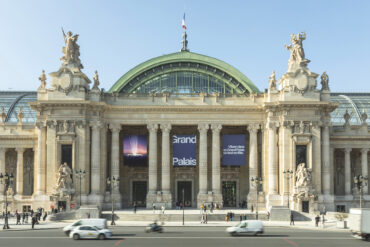
“Design sur Cour” remains one of the festival’s most popular sections, inviting visitors to wander through the capital’s historic settings and rediscover landmark sites from a fresh perspective, as architecture, design and scenography come together in striking harmony – as at the Musée Bourdelle, which welcomes Anthony Guerrée. This year, the Colonne de Juillet on Place de la Bastille is transformed by Studio 5.5 using an almost limitless raw material: discarded clothing sourced through Refashion’s collection network. At the Arc de Triomphe, meanwhile, Jérémy Pradier-Jeauneau has conceived La Tempête, an immersive installation that reveals the monument in an entirely new light, from its base all the way to the top. At the Rotonde d’Antin in the Grand Palais, Julien Sebban and the Uchronia collective have drawn inspiration from the venue’s historic floral motifs to set the scene for Le Grand Bouquet, a collaborative work bringing together a wide range of crafts and expertise. Irish cabinetmaker Joseph Walsh, meanwhile, takes over the Orangerie, gardens and Cour d’Honneur of the Hôtel de Sully, while Johana de Clisson transforms the gardens of the Hôtel de Soubise with her sculptural white-stoneware planters, inspired by the formal vocabulary of the classic French garden.
Finally, the Hôtel de la Marine promises its own share of surprises. In the Cour de l’Intendant, Antoine Tauvel of Maison Lacmé studio presents Astre Mobile, a transparent Méhari unlike any other. And in the State Rooms, the Hanjimania exhibition opens up a creative dialogue between France and Korea around hanji paper, which is currently on its way toward recognition as UNESCO Intangible Cultural Heritage.

Vous aimerez sûrement les articles suivants…